Posts Tagged by Amazon Watch
Ecuador — Achieving Justice in the Chevron Case?
| January 6, 2012 | Posted by Craig Shields under Fossil Fuels |

30,000 people in Ecuador are one step closer to achieving justice in their case against Chevron. On Wednesday, an appellate court upheld the $9.5 billion judgement that would force the oil giant to pay for the clean up of a huge tract of land, damaged by Texaco, before its acquisition by Chevron. If you have a strong stomach, the talking points of the Chevron C-suite and PR team are at ChevronThinksWe’reStupid.org. And here’s a video made by Amazon Watch, a small but fierce non-profit that’s been working hard to focus world attention — and bring justice — to this horrific matter.
But how close are we to a resolution? Don’t hold your breath. As I’ve mentioned, Chevron’s team of attorneys is among the largest and most talented bunch of people on Earth. They’re playing for blood, and they’re licking their chops over the success that ExxonMobil enjoyed in dragging out its payment on the Valdez oil spill in Alaska for more than 25 years before agreeing to pay a small portion — over a quarter of a century later. No fewer than 8000 beneficiaries of the ExxonMobil restitution died while they were waiting for their money to come in.
This looks like a long, hard slog.
Related posts:
Chevron’s Situation in Ecuador Won’t Be Easily Dismissed
| May 13, 2011 | Posted by Craig Shields under Renewables - Business |
It looks like Chevron’s situation in Ecuador is coming to a head. In a couple of weeks, the oil giant will face a watershed event in the court case in which it’s been ordered to pay $9.5 billion to repair the damage it did (operating as Texaco) to the people and environment of this formerly pristine part of the Amazon jungle. Here’s a video made by Amazon Watch, a small but fierce non-profit that’s been working hard to focus world attention — and bring justice — to this horrific matter.
In my mind, what makes this all the more disgusting is where it happened, and why it happened there. We’re talking about a company whose leaders premeditated to commit an atrocity in a part of the world populated with men, women and children in whom “civilization” simply has no interest. The people of the entire region are invisible; they hold no currency; they do not matter. If they had perpetrated the same thing in the US, the executives responsible would have been making license plates for the next 15 – 20 years — and they knew it. We have clear laws in place — and a judicial system that does manage to lock up an occasional CEO or two for gross violations. So the folks in charge thought they would make some money by destroying a remote part of the world, and its forgotten people — all with total impunity.
And even though decades of jurisprudence finally produced a crystal-clear guilty verdict, they just might pull it off. Chevron has deployed many hundreds of the world’s finest and best-paid litigators to the case, and have vowed to fight this to the bitter end. Besides, they must be heartened by the success that ExxonMobil enjoyed in dragging out its payments on the Valdez oil spill in Alaska for more than 25 years before agreeing to pay a small portion — over a quarter of a century later. No fewer than 8000 beneficiaries of the ExxonMobil restitution died while they were waiting for their money to come in. I have to imagine that Chevron finds this travesty most encouraging.
Sorry to have to bring you news like this. And it’s not all that good for me either, as I routinely take considerable flack when I present stuff of this kind.
But I do it anyway.
Related posts:
Amazon Watch
| December 19, 2009 | Posted by Craig Shields under Renewables - Politics |
Reader Jacob Silver writes:
Non-absorbed carbon in the atmosphere is thickening the carbon filter of solar energy. With the loss of hundreds of thousands of acres of forest cut down in Indonesia and Brazil, the result is a gap of 25% non-absorbed carbon. This has already created an atmospheric carbon index of 390 ppm, with an increase of 2 ppm each year.
It’s coincidental that you mention the importance of the rainforests. As it turns out, my wife, who recently exited with the world of horse breeding, will soon be speaking with the good people of Amazon Watch re: a new career as environmental guardian. I truly hope it works out, as advocating for eco-stewardship is a great chance to make the big bucks. (Just kidding.)
I’m reminded of the magical night I had in Los Angeles a few months ago at a screening of the movie Crude (which I heartily recommend), and meeting a few of the filmmakers. It was a great honor to hang out with people who have dedicated their lives to such an honest and beautiful cause. I’m reminded in particular of Amazon Watch’s Atossa Soltani (pictured here) whom I’ve described as “a fierce but kind fireball of passion and energy for the cause of the Ecuadorian people.”
For those who may not be aware of the story, Crude is a documentary that lays out the history of one of the world’s most horrible tragedies – tragic mostly insofar as it did not have to happen. In brief, oil giant Texaco began looking for oil in Ecuador in 1964 and pursued that goal for decades, with dirty, low-cost processes that would have landed anyone associated with them in jail had they been performed in the US. The company knowingly ruined a huge part of the rainforest, resulting in the sickness and death of tens of thousands of innocent indiginous people. Now, Chevron, who acquired Texaco in 2001, has focused its throng of lawyers on the task of evading responsibility for the crimes.
Those wishing to learn more can do so at Amazon Watch. It would certainly be a happy day for us at the Shields family to have one of on the staff of such a fabulous team of people.
Related posts:
Crude – The Movie
| September 18, 2009 | Posted by Craig Shields under Renewables - Politics |
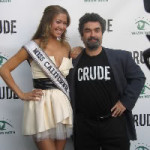
I was fortunate enough to have been invited to the Los Angeles premier screening of the movie “Crude” by filmmaker Joe Berlinger (pictured at left with Miss California) last night in Hollywood. It was a great honor being part of a cause so honest, and to be given the opportunity to meet people like Amazon Watch’s Atossa Soltani (below) – a fierce but kind fireball of passion and energy for the cause of the Ecuadorian people.
For those who may not know the story, Crude is a documentary – quite fair-minded in comparison to most – covering the history of one of the world’s most terrible tragedies – tragic mostly insofar as it did not have to happen. In brief, Texaco began its exploration for oil in Ecuador in 1964 and pursued that effort for decades, with processes so impure that they would have landed anyone associated with them in jail had they been performed in the US. The company knowingly ravaged the rainforest, and caused the sickness and death of tens of thousands innocent people living in the area. Now, Chevron, who acquired Texaco in 2001, is working hard to evade responsibility for the crimes of the company it owns. Those wishing to learn more can do so at Amazon Watch.
In any case, this film is truly a story of power, mystery, beauty, and evil – all presented in a straightforward manner that respects the intelligence of its audience.

I won’t give away the ending – in fact, I couldn’t even if I wanted to. There is no reason to believe that this litigation will ever end, as Chevron continues to astound the world, finding inventive new ways to postpone justice and fairness. If you think I’m exaggerating, I urge you to consider the case of the Exxon Valdez. No one at ExxonMobil disputes sole resonsibility for the disaster, yet they were successful in delaying paying off the damages until just this year — more than 20 years after the incident (and at the last minute prevailed upon a judge to reduce those damages by 80%). To me, it’s hard to guess when we could reach a conclusion in the case of Chevron.
But speaking of conclusions, one that I personally find obvious is that white people have treated people of color very badly all around the globe for many hundreds of years. This fine film is a reminder that there is precious little evidence that this pathology has slowed – or that it ever will.