Posts Tagged by Chevy Volt
Prospective Electric Vehicle Owners Analyze Break-Even Point on Fuel Costs
| May 10, 2012 | Posted by Craig Shields under Electric Vehicles |

Cameron Atwood writes:
I recall seeing figures indicating the $45k Volt pays off the difference in savings on gas over electric cost over its ICE (internal combustion engine) brethren in six years. That’s not especially dismal.
It depends on how far you drive, and, in the case of a plug-in hybrid like the Volt, how you drive, i.e., how seldom you exceed the battery-only range (about 35 miles) and start to use gasoline. The analysis is easier with a battery electric like the LEAF. Let’s say: Read More
Extended Range Electric Vehicles and Plug-in Hybrids
| April 11, 2012 | Posted by Craig Shields under Electric Vehicles |

Frequent commenter MarcoPolo writes:
Craig, EREVs (extended range electric vehicles), are not simply ‘Plug-in hybrids’. The GM Volt is an astonishing example of US engineering, and advanced technology. All Americans should feel proud of the GM Volt.
I have to admit that it’s a cool idea, and I’m glad that GM appears to be onboard with a migration, albeit a slow one, away from oil. But I do believe that the EREV (as they call it) will be a short-lived concept that will have little bearing on the future of transportation.
Btw, the difference between the terms “extended range electric vehicle” (EREV) and “plug-in hybrid” is semantics. In fact, I recall thinking when I saw that GM had coined the phrase EREV in an attempt to differentiate the Volt from the other plug-in hybrids, “Now that’s marketing at its finest.” All such vehicles have batteries that provide a given range, and internal combustion engines (ICEs) that extend that range. Yes, there are variations on the theme as to what precisely the ICE does (charge the battery? power the car? both?) But we’re really talking about a single concept.
Plug-In Hybrids: Now THAT’S Complexity
| April 11, 2012 | Posted by Craig Shields under Electric Vehicles |

Here’s a wonderful video that explains the multiple drivetrains at work in the Chevy Volt. A couple of immediate impressions:
1) No wonder the price on this sucker is $41K, with all that going on. The bill of materials (costs of the individual components) must be enough to choke a horse. And the non-recurring engineering costs must have been staggering.
2) This further amplifies my belief that plug-in hybrids really are not the answer to transportation. It’s like using an elephant gun to kill mice. Electric transportation will succeed when we get the price, energy density, and power density of batteries into an acceptable range – and, of course, when we can get enough renewable energy on the grid that we’re not charging them with coal.
So when will this happen? The question is political will. If we rely 100% on market forces, especially while we continue to subsidize fossil fuels, it could be A Long Way to Tipperary.
Big Advancements in Electric Vehicle Batteries
| February 29, 2012 | Posted by Craig Shields under Electric Vehicles |

A reader asks my opinion of Envia Systems‘ lithium-ion battery. I reply:
If these claims are true, it’s a really important breakthrough — potentially even more significant than that of my friends at Eos Energy Storage.
The number one issue that electric vehicle nay-sayers throw in the face of us advocates is resistance of battery technology to rapid change: both in terms of cost and energy density. In particular, they say that where Moore’s Law (the idea that the functionality of technology increases exponentially over time) applies to things like integrated circuits, it absolutely does not apply to power systems like motors and batteries. I believe the truth is probably somewhere in the middle, and perhaps this is evidence of that. We’ll see.
Predicting the Electric Vehicle Adoption Curve
| August 4, 2011 | Posted by Craig Shields under Electric Vehicles |
Here’s the presentation — including the audio track — that I made to the Electric Vehicle Summit at the Biltmore Hotel in downtown Los Angeles last week.
In essence, my point is that, though I’m bullish on the EV adoption curve, and I’m excited that for once, the good guys have a chance to win big, there are several open questions. In particular, there are so many variables here that have the potential to turn the world upside down, that it seems a bit foolish to me to think that predictions that go out 40 years have any real meaning.
Having said that, EVs are vitally necessary to the well being of all of us. Sustainability (generally) can only come from national security, which requires energy security, which in turn requires weaning ourselves off of oil. And there are other imperatives as well:
Health: We spend $250 billion a year dealing with the lung damage caused by the inhalation of the aromatics of fossil fuels.
Peak oil. We’re running out of oil.
Long-term environmental damage: Global climate change and ocean acidification.
Yet I grant that EV naysayers have some good points:
Drivers demand absolute freedom, and will not deal well with range anxiety.
Consumers are risk-averse; no one wants to invest $30,000 in the automotive equivalent of the Betamax.
Most (though not all) consumers refuse to pay extra for a benefit that accrues to everyone (eco-friendliness).
Even if this weren’t the case, there is widespread confusion and apathy about the true ecological benefits. I’m astonished by the effectiveness of the PR team that has convinced a significant number of Americans that global climate change does not represent an important problem. Morally, they’re certainly not very upright people, but I have to respect their effectiveness.
So, how to promote EVs in the US? I would consider appealing to a sense of patriotism, as there is nothing one can do that is better for the strength of our country as a whole than ceasing our reliance on oil. Simultaneously, this would:
Reduce the power, and thus the threat, of terrorism,
Remove a great deal of the motivation for war, and
Stop the outflow of US cash to the tune of $1 billion per day.
In any case, I hope you’ll enjoy the presentation.
2GreenEnergy Video Report: Electric Transportation
| April 12, 2011 | Posted by Craig Shields under Electric Vehicles |
Here, 2GreenEnergy Video Report host George Alger interviews me on the subject of electric transportation. We cover fuel-cell and battery EVs, the most likely consumer adoption curve, and the imperative on the part of the OEMs to begin to produce EVs.
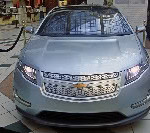
[The Vector] Chevy Volt – A Vehicle with Scarcity Value
| February 24, 2011 | Posted by Aedan-Kernan under Electric Vehicles |

For all the attention it is receiving, the Chevrolet Volt is not going to change much about the typical vehicle GM sells.
Chevrolet Volt Marketing Director Tony DiSalle said on July 2 that they plan to produce 10,000 Volts by the end of 2011, and an additional 30,000 Volts during 2012 at its Detroit-Hamtramck facility. In Europe, a sister car, the Ampera, is due to go into production roughly 12 months after the Volt.
During 2011 and 2012 GM will produce approximately 7 million vehicles that run on hydrocarbon fuels. Read More
Electric Vehicles Offer a Bright Future
| December 3, 2010 | Posted by Craig Shields under Electric Vehicles |

I notice that 17 people have responded with comments thus far to my recent piece on Renewable Energy World in which I discussed plug-in hybrids and the Chevy Volt in particular. Although the purpose of my original article was to call for a simplification of our industry jargon, I can now see that there is a certain amount of inherent complexity to the whole concept of electric transportation and how clean it is.
Readers may wish to wade through each of these comments; it’s certainly an instructive exercise. But I would summarize the situation as follows: Read More
Plug-In Hybrid Electric Vehicles and Their Enemies
| November 28, 2010 | Posted by Craig Shields under Electric Vehicles |

I note a certain level of confusion surrounding plug-in hybrid electric vehicles. And I can certainly understand some level of bewilderment, as there are numerous variations on the plug-hybrid theme – as well as jargon that, in my opinion, serves to make the matter even worse — BEVs, ZEVs, PHEVs, REEVs, etc. But it’s clear that the enemies of electric transportation, whose motives remain unclear to me, are capitalizing on this moment of confusion to seize the day and turn people away from an important advancement in clean transportation.
In particular, I noted the recent fracas that resulted when GM announced the specifics behind the Chevy Volt’s drivetrain. Conservative columnist George Will loudly accused GM of deceit. “It’s just a hybrid!” he and his fellow cynics screamed last week, somehow overlooking the fact that many Volt drivers will never need to put a drop of gasoline in their cars.
I have to say I was stunned. Isn’t George Will an intellectual? Read More
Comments to "GM and the Chevy Volt – Can They Be Trusted?"
| November 1, 2010 | Posted by Craig Shields under Renewables - Business |
I received no fewer than 19 comments (and counting) to the post I put up on Renewable Energy World on “GM and Chevy Volt – Can They Be Trusted?” I knew this would be a hot topic.
I notice how many people use metaphors and other comparisons to make their point.
“The EV industry is in the same state as the auto industry was when man carved wheels out of rock,” one writes, in an effort to show how much further the relevant technologies are bound to improve. Not bad; I can see that.
Then you have a guy who refers to “Who Killed The Electric Car” as “propaganda” and compares it to the work of Joseph Goebbels in Nazi Germany. I don’t know, pal. Everyone’s entitled to his own opinion, and I appreciate your flair for the dramatic, but that’s really out there.
One reader worked hard to make the case against distributed power generation, and found an original way to point out the need for scalability that comes from centralization. ”Do you raise your own sheep for wool, and cows for slaughter?” he asks. That’s some creative reasoning, but spurious as an analogy.
In any case, I love the dialog. Let’s keep it flowing.