Posts Tagged by fuel cells
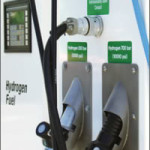
A Collaboration on Fuel Cell Vehicles — But Exactly Whose Interests Are At Stake? Not Yours.
| December 18, 2011 | Posted by Craig Shields under Electric Vehicles |

Here’s an article that describes a collaboration between GM and BMW on fuel cell vehicles.
Wow, that’s remarkable. Just when I had started to trust the car companies based on the sincerity of Nissan/Renault CEO Carlos Ghosn and his people who build and promote the LEAF, I see this. A few basic points:
• The oil companies are the main supporters of the hydrogen economy. They see hydrogen as a mechanism for them to continue to retain a service station which will continue to provide the consumer with something they can pump. Electricity, on the other hand, is ubiquitous.
• Creating hydrogen suffers a 4:1 efficiency issue. I.e., generating hydrogen in a renewable way requires four times the number of solar panels that would be needed to make the electricity to put into my battery. Read More
Related posts:
Electric Vehicles – Batteries and Fuel Cells
| November 11, 2009 | Posted by Craig Shields under Electric Vehicles |

Honda’s Steve Ellis is one of the world’s foremost authorities on the subject of alternative fuel vehicles and their commercial trajectory. He happened to be a fellow speaker at last month’s AltCarExpo in Santa Monica, and I’m proud to count him among my friends. We’ve have had several meetings over the past year or so, from which I’ve learned how much more there is to the subject of fuel cells than most people realize. In an interview last night, Steve reviewed the subject with me from top to bottom, forming the basis of an important chapter in my book on renewables.
While they were fresh in my mind, I thought I’d note a few of the most interesting highlights from Steve’s presentation:
- Of those who know anything at all about fuel cells, most have opinions that are based on sources that have made essentially no effort to treat the subject fairly.
- It is true that the process by which hydrogen (the “fuel”) is electrolyzed from water and then, in the car, recombined with oxygen to form water is less efficient that the process of storing electrical energy in a battery and converting it to kinetic energy in an electric motor. However, this is largely missing the point; there are far more important factors that affect fuel cells’ utility in transportation that are normally overlooked.
- Both types of electric vehicles (fuel cell and battery) offer the potential for completely clean transportation; the issue is how the energy is generated in the first place.
- Over the past few years, the efficiency of fuel cells has improved faster than the relevant statistics (energy density and cost) of batteries.
- Technologies by which drivers can refuel their cars for longer trips will bedevil the battery electric vehicle market for the foreseeable future. Better Place is not a good fit for the US, and ubiquitous quick-charging is many decades away, if it ever comes at all. So if you want clean vehicles that can be refueled in a matter of a few minutes (versus many hours), hydrogen is your only answer.
I guess the most memorable moment of the interview was the concept of personal emotion and politics. Steve is at a loss to understand why people with a sincere devotion to environmental stewardship would manipulate the facts to denegrate a technology that is strategic to moving us in the right direction. “This is truly strange behavior. Fuel cell advocates don’t try to derail the battery industry. It’s obvious that both have strengths and weaknesses, and form complementary paths in our journey to clean transportation.”
I guess we’d all like to think that meeting the challenges of reducing our carbon footprint are purely technological, rather than political. Or — if the challenges in fact do have political components that it’s “the good guys against the bad guys” — and that there is a kind of “brotherly love” among the fans of renewable energy and electric transportation. But my recent interviews have suggested that this is not the case. All I can say is what I remind my kids of constantly: This is not going to be easy. Let’s not fight among ourselves and make it impossible.
Related posts:
Hydrogen – Back Like a Rash
| October 6, 2009 | Posted by Craig Shields under Renewables - Science |
To my utter astonishment, we in the US and Europe are begieged with renewed interest in hydrogen. I urge readers to arrive at their own understanding of the merits of hydrogen as a carrier of energy. But for those who may be unwilling to go through the process and are looking for a readers’ digest version, here are three simple data points (as usual: the science, the business, and the politics) that clarify what I think everyone ought to know about hydrogen.
The science: Hydrogen in its pure form is rare, because it combines so readily with other substances, releasing energy in the process. It can be burned (combining it with oxygen to form water) or used in a fuel cell, (i.e., pulling the electron off and moving it through a separate electrical path from its proton, again, ultimately combining with oxygen). But energy is required to create this pure hydrogen such that we can then harvest useful work from these processes. And the mechanisms by which hydrogen is generated (e.g., electrolysis) and then the energy is gathered from burning or fuel cells are three times less efficient than the standard mechanisms by which electrical energy is generated, stored in batteries, and then converted back into useful work through electric motors.
The business: It is true that civilization will face issues in building out the electrical grid to provide ultimately a complete network of convenient and safe charging stations for electric vehicles. But the electrical grid has a 130-year headstart on whatever delivery mechanism is proposed to serve up hydrogen over the enormity (3.5+ million squares miles) of a place like the United States. In addition to being far more efficient, electrical energy is already available in the vast majority of homes and work places.
The politics: In my opinion, the idea that we should take an inefficient carrier of energy and use to to create “hydrogen highways” could only have come from someone who really doesn’t want alternative fuels ever to see the light of day, and is disguising this malice in a not-too-clever way. And those of you who have seen “Who Killed The Electric Car” will recognize that this is hardly an original idea.
Not too long ago, it appeared that the powers of reason and decency had made their case effectively, and this distraction had been shelved; in fact, Energy Secretary Steven Chu’s DoE defunded hydrogen at the federal level earlier this year. But it’s back with a vengeance. For example, California, while teetering on the edge of bankruptcy, is subsidizing the hydrogen highway with public funds.
And ask yourself why this is happening, and who will be delivering this hydrogen (assuming it ever happens). ExxonMobil and Chevron. Hey, guys: You make $10 billion in profit each quarter. If you really want this to happen, do you mind paying for it yourselves? How dare you ask the taxpayers to pay for this folly, when you and only you will profit from it — on the off chance that it ever happens?
There you have it, the 1-2-3 of hydrogen energy. If only it were that easy to make it go away.