Posts Tagged by GM
A Collaboration on Fuel Cell Vehicles — But Exactly Whose Interests Are At Stake? Not Yours.
| December 18, 2011 | Posted by Craig Shields under Electric Vehicles |

Here’s an article that describes a collaboration between GM and BMW on fuel cell vehicles.
Wow, that’s remarkable. Just when I had started to trust the car companies based on the sincerity of Nissan/Renault CEO Carlos Ghosn and his people who build and promote the LEAF, I see this. A few basic points:
• The oil companies are the main supporters of the hydrogen economy. They see hydrogen as a mechanism for them to continue to retain a service station which will continue to provide the consumer with something they can pump. Electricity, on the other hand, is ubiquitous.
• Creating hydrogen suffers a 4:1 efficiency issue. I.e., generating hydrogen in a renewable way requires four times the number of solar panels that would be needed to make the electricity to put into my battery. Read More
Comments to "GM and the Chevy Volt – Can They Be Trusted?"
| November 1, 2010 | Posted by Craig Shields under Renewables - Business |
I received no fewer than 19 comments (and counting) to the post I put up on Renewable Energy World on “GM and Chevy Volt – Can They Be Trusted?” I knew this would be a hot topic.
I notice how many people use metaphors and other comparisons to make their point.
“The EV industry is in the same state as the auto industry was when man carved wheels out of rock,” one writes, in an effort to show how much further the relevant technologies are bound to improve. Not bad; I can see that.
Then you have a guy who refers to “Who Killed The Electric Car” as “propaganda” and compares it to the work of Joseph Goebbels in Nazi Germany. I don’t know, pal. Everyone’s entitled to his own opinion, and I appreciate your flair for the dramatic, but that’s really out there.
One reader worked hard to make the case against distributed power generation, and found an original way to point out the need for scalability that comes from centralization. ”Do you raise your own sheep for wool, and cows for slaughter?” he asks. That’s some creative reasoning, but spurious as an analogy.
In any case, I love the dialog. Let’s keep it flowing.
Can We Trust General Motors?
| October 15, 2010 | Posted by Craig Shields under Electric Vehicles |
You’ll travel far to find someone with more provocative and important observations on the subject of transportation than Chelsea Sexton. Read More
Electric Vehicle History — Setting the Record Straight

| April 12, 2010 | Posted by Craig Shields under Electric Vehicles |
My much respected friend Wally Rippel asks that I publish something to set the record straight on the early days of electric transportation. Here goes:
According to the movie Who Killed the Electric Car? “after the success of the Sunraycer, GM contacted AeroVironment and asked them to work on the development of an electric car.” Well, this is absolutely not true. What really happened was that AeroVironment submitted an unsolicited proposal to GM in early 1988 which was based on a 1985 proposal generated jointly by AeroVironment and me. This earlier proposal (code named “Electrospirit” was submitted to GM, but was not funded.
At the time, I was part of JPL’s Electric Power section and was working on AC drives and sealed lead acid batteries. The idea was that JPL and AeroVironment would join forces to develop a high-performance electric vehicle, based on the propulsion work I was carrying out at JPL — and on AeroVironment’s strengths in connection with aerodynamics and light-weight structures. This later proposal (code named Santana) was funded after much arm-twisting and politics — and lead to the development of the EV-1. The original concepts generated by me at JPL were central to the EV-1 (induction motor, integrated charging, high voltage battery bus, various control techniques, cooling techniques were all elements brought forward from JPL to GM).
This is important history, as it establishes the origin of the modern electric car development. For me and my family, it is of course important as it provides a fair account of my involvement. The leadership at AeroVironment is well aware of this error, but has not been willing to come forward – likely because of their connection with GM. (For many years, Ken Baker, a former GM executive, was one of AeroVironment’s Board of Directors.)
Without this correction, history reads that GM got the ball rolling with their initiation of the EV-1 project.
Thoughts on the EV Adoption Curve
| March 16, 2010 | Posted by Craig Shields under Electric Vehicles |
Every so often, I like to write a short article that gets us thinking about the rate at which electric vehicles will be assilimated into our culture and brought onto our roads, replacing internal combustion engines. Here are a few ideas to consider.
1) What does Big Auto think (or, at least, claim that they think) about EV production rates? Considering there are 230 million cars on the road in the US alone, the needle will not be moving in the short-term:
Nissan: Has pre-orders for 56,000 LEAF all-electric cars.
GM: Last year, had 50,000 expressions of interest in the Chevy Volt, though presumably that figure is somewhat larger now.
Mitsubishi: Bumped up its 2011 production schedule of the i-MiEV from 8,500 units to 9,000.
Better Place: Placed an order with Renault for 100,000 electric vehicles based on the Fluence ZE for its deal with Israel.
2) But is there any reason to believe anything coming out of Detroit?
Today, the population of Detroit is about half of what it was in 1950. The city has 33,500 empty homes and 91,000 vacant lots. A recent AP article asserts that vacant property totals 40 square miles. But Big Auto is not at all apologetic for the meltdown, and points out they couldn’t have foreseen the dynamics of oil prices that created sharp inflection points in the demand for fuel-efficient vehicles in favor of the Hummer and other gas-guzzlers. If this is false, they’re disingenuous; if it’s true, they’re incredibly obtuse. Either way, it’s hard to trust what they’re saying.
One thing for sure: there is nothing good in EVs for the big OEMs. They are happy to drag this transition out for decades, selling gas- and diesel-based cars and trucks as long as possible.
3) The Department of Energy apparently is not bullish on pure (battery) EVs.
Check out this report on the future of the automobile. Although the author sees lots of hybrids in our future, he really doesn’t see any pure EVs. Remarkable. I have to think this is simply a mistake.
4) Industry analysts are hedging their bets.
As reported in EV World, Accenture recently performed a survey that showed that six out of 10 consumers are more likely to buy a hybrid or electric vehicle “only when it is superior to gasoline-only models in every way.”
I understand that merely “being green” isn’t good enough for the vast majority of car buyers. But this report strikes me as the usual MBA malarky — a consultant who reads your watch and then tells you what time it is. What about the other 40%? Isn’t that a substantial market? And what exactly does “superior in every way” mean, exactly? How will the typical consumer react to a value proposition that includes dramatically lower fuel cost and huge reductions of other pieces of his total cost of ownership?
My belief: Give me a freeway-speed battery EV with comparable fit and finish to a garden-variety 5-passenger sedan, a 75-mile range, and price tag under $25,000 after rebate, and you won’t be able to manufacture enough of them.
Peak Oil
| January 25, 2010 | Posted by Craig Shields under Renewables - Business |
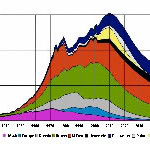
I’m hoping that readers of my upcoming book on renewables will enjoy my conversation with Matt Simmons, arguably the loudest voice on the issue of peak oil. And, although the subject remains controversial, it’s probably a good deal less so today that it was last week, now that two extremely senior automotive industry executives have come out with statements that support it.
In particular, note the recent comments of GM’s Bob Lutz, global climate change skeptic, who is nonetheless a strong proponent of the Volt and the electrification of the automobile. Lutz argues that continued dependence on oil as demand inevitably increases will simply exacerbate boom and bust economic cycles. He notes that, in 20 years the China auto market will equal the rest of the world combined and adds, “At that point we have to have alternative drive systems, which to me have to be electric.”
And check out the remarks of Jim Lentz, President and COO of Toyota Motor Sales. He apparently stunned his interviewer during a recent Commonwealth Club event, in which he stated unequivocally that Toyota believes that peak oil will occur sometime in the later half of this decade.
Peak oil – just one of the many reasons for the rapid migration to renewable energy.
We certainly see a great deal of the old “David and Goliath” metaphor in our conversations in this industry – especially in electric transportation. Though a number of EV start-ups have gone belly-up over the past few years, there are still many such Davids, feverishly ramping up to take on the Goliaths of Nissan, GM, and the other traditional automakers.