Posts Tagged by market research
Cleantech Entrepreneurs: The Most Sincere Response to a Market Research Survey Is a Check In Your Hand
| November 9, 2011 | Posted by Craig Shields under Renewables - Business |

Last night’s talk at Catalyst for Thought was on the subject of validating one’s market, which happens to be the core of the business I ran for almost 30 years. Thus I heard a great number of my own words reflected back to me, e.g.,
Where most new businesses go through the steps: 1) design, 2) build, 3) sell, it’s a good idea to consider this drastic re-write: 1) sell, 2) design, 3) build.
So many times I’ve asked people, “So you think you need to raise a few million dollars of venture funding, which, if you get it at all, will come at an enormous cost to you? Wouldn’t you rather have a few million dollars in purchase orders from customers?”
Bottom line: you can have a very short business plan if you have a very long customer list. And it’s not as hard as it seems.
Related posts:
2GreenEnergy Video Report: Electric Vehicles — Using Market Research Processes to Gauge Market Size
| April 30, 2011 | Posted by Craig Shields under Electric Vehicles |
In this episode of the 2GreenEnergy Video Report, I discuss the use of market research to gauge the overall size of a target market.
Related posts:
Excellence in Market Research
| May 29, 2010 | Posted by Craig Shields under Electric Vehicles |
In response to my complaint about Deloitte’s recent market research study on electric vehicles in which it was clear (to me at least) that they had surveyed irrelevant people as thus missed the mark with their conclusions, a gentleman named Gus wrote:
I believe that the comment “…the same critical mistake that most people do: survey the wrong people…” is at the root of the problem. Who are the right people then? Only the ones who think the way we do?
This is an astute comment. I’m not saying that these “irrelevant” people are not fine human beings. My mother, for instance, is a kind, intelligent and loving woman. But I can assure you, insofar as she’s extremely unlikely to by an electric vehicle – now or ever — any research process that included her opinion on the subject would be, to that degree, misguided.
The reason I regard your comment as astute is that it highlights one of the true art-forms that lies at the base of all good research: walking the tightrope of assumptions. When we assume too little, we wind up with soup – with generalized garbage that does not point the way to answers. Conversely, if we assume too much, we prove little more than we’ve already assumed, and we wind up with equally useless circular logic, e.g., More than 90% of all qualified homebuyers are those with both the current willingness and the ability to purchase a dwelling.
Market research looks easy — until you try it yourself. There are many ways to ruin a project — and until you make some of those errors and learn from your mistakes, it’s really not a piece of cake.
Related posts:
EV Adoption Curve — Market Research of Questionable Validity
| May 19, 2010 | Posted by Craig Shields under Electric Vehicles |
My fine friend and 2GreenEnergy associate Terry Ribb did a long and productive stint at Deloitte Consulting, and thus I tend to put special value on the reports I get from that esteemed organization. But when it comes to market research, they seem to have made the same critical mistake that most people do: survey the wrong people. Here’s their recent report on the EV adoption curve.
Do you note anything startling?
In response to Deloitte’s question, “From whom would you be most likely to purchase an EV?” the top three responses are Toyota, Honda and Ford – none of which even have EVs in production yet — and two of the three — Honda and Toyota — are openly waffling on the idea.
The report goes on to suggest that Nissan needs to work extra hard to promote its LEAF, since it seems not to have been noticed by EV buyers. Bull manure. I find it hard to believe that almost anyone of any real relevance to the survey would have named Nissan with its LEAF, GM with its Volt, Mitsubishi with its i-MiEV, BMW with its Mini-E — or any of dozens of other serious EV programs from established and new OEMs.
Think about this. If you were conducting an interview about attitudes towards professional baseball, and the respondent couldn’t name a single major league team, could you imagine any real value to the rest of the interview? My only take-away from this report is that the research effort itself missed the mark.
Here’s another post further confirming that Deloitte is taking a very strange perspective with respect to the EV adoption curve.
Related posts:
Clean Energy and Market Research
| March 22, 2010 | Posted by Craig Shields under Renewables - Business |
One of my most important jobs here at 2GreenEnergy is speaking with the few dozen people who call or write each week looking for help with their clean energy projects. I conduct these interviews with an eye toward helping out in some fashion in any of the wide range of disciplines that is represented by our Associates: engineering, IP protection, raising capital, etc. But in truth, my first thought is to look at the caller’s problem as a marketing challenge. In the words of a friend of mine, “I’ve never seen a business problem for which more sales revenue was not the solution.”
In particular, I find myself repeating the same advice: conduct market research. Whether you do it yourself or outsource it to a team like ours, you need to find a rigorous, disciplined way to develop a profound understanding of your target customer segments.
Establish market demand — by segment. What do various kinds of people want? Why do they want it? How and where do they want to buy it? How are their workstyles and playstyles changing in ways that are most relevant to the matter at hand? What are the gut-wrenching emotional issues that are keeping them up at night – and how does what you’re offering address those topics?
I was looking at an old project database the other day and had a realization that made me feel kind of, well, old. Since I started out in the early 1980s, I’ve done more than 800 market research projects — for clients on five continents: IBM, H-P, Sony, 3M, Xerox, Philips, Pioneer, Magnavox, Mitsubishi, Porsche, AT&T, FedEx – not to mention hundreds of smaller, venture-capitalized start-ups and the like. From those research efforts were sprung some of the most well-known – and (at the risk of appearing immodest) most successful, highest-ROI campaigns the business-to-business marketing world has even seen.
If you’d like to discuss your venture in the context of market research, please don’t hesitate to contact us; we’d love to chat about your specific mission.
In fact, feel free to call right now; just hit “contact.” I’m in the office all this week — on and off the phone — as usual.
Related posts:
Will the Dogs Eat the Dogfood?
| February 1, 2010 | Posted by Craig Shields under Renewables - Business |
I’ll never forget the first time I heard this expression — which is, of course, a rather crude way of asking if a certain product or service has appeal to one or more target market segments. I was sitting in a meeting with a few of my clients at IBM when someone asked me for my opinion on the subject. I tried to conceal that I felt vaguely insulted, as I had built my career around the process of asking and answering this question – and I guess I wasn’t flattered by having it reduced to level of unrefined simplicity.
But I urge readers to develop and implement processes that get at these market basics. As yourself tough questions:
Who needs what I’m selling? Exactly why? What are the gut-wrenching needs of my target market that are addressed uniquely by my product or service?
Once those basics are in place, get at higher levels of refinement:
How should I position my product or service? I.e., how should I communicate my offering in a word or two that will generate an immediate and positive association in the mind of the market? What exactly is my brand — and what’s the best way to express its meaning?
An electric vehicle company near Atlanta called Tomberlin has a sport buggy called the “Anvil.” In the very name of the product, they’ve positioned it as a heavy, low-tech object – normally stationary – which, when it happens to be in motion, usually brings to mind falling to earth, causing injury. To say the very least, I would have recommended against that. (You may think I’m making this up. I’m not; check it out here.)
Yet the process of deriving correct (or incorrect) positioning is seldom as clear-cut as this. Excellence in this space is critically important, but it’s not a straightforward task. In any case, if you’d like help on this — or any other aspect of marketing your clean energy product or service, please don’t hesitate to call or write. CONTACT US HERE.
Related posts:
Clean Energy Businesses Need Precise Market Insights
| January 22, 2010 | Posted by Craig Shields under Renewables - Business |
I thought it might be a good idea to make a list of the types of activities that have been most helpful to our clients in renewable energy and electric transportation. At the top of that list is market research.
As I’m fond of saying, “It doesn’t matter what you think, or what I think; we’re not buying the product or service. What matters is what the market thinks.”
Let me ask you ten quick questions:
1. What market segments have the most intense demand for your product or service?
2. What are the gut-wrenching emotional issues that keep your prospects up at night?
3. What sources of information do they trust most highly?
4. What price-points are most attractive for what you’re offering?
5. What positioning statements communicate an instant understanding of — and attraction for — your product or service?
6. What are the most critical frustrations in your prospects’ professional (and private) lives that motivate them to take risks and make big-dollar commitments?
7. How do your prospects see themselves? What is their self-image, and how does that affect their decision-making?
8. What are your prospects’ key aspirations that drive their purchasing behavior?
9. Through what sales channels are your target market segments most likely to purchase?
10. What would motivate channels partners (reps, dealers, distributors, OEMs, etc.) to embrace a partnership agreement with your company?
If you have airtight answers to these questions, that’s great. But if you’d like to discuss a rigorous and disciplined yet low-cost way to derive rock-solid data points on these and other strategic business issues, please let us know. CONTACT us here.
Related posts:
Sharpening Our Focus on Business
| December 30, 2009 | Posted by Craig Shields under Renewables - Business |
New Years is a time-honored opportunity to make mid-course corrections in one’s activities in life. To that end, let me talk briefly about the business side of 2GreenEnergy, and note that all of us here at 2GreenEnergy intend to make this even more robust in 2010.
I hope readers have noticed our “Associates” page – but I would understand if they hadn’t. To date, we haven’t done too much promotion of this robust team of professionals, focused on helping renewable-energy-based businesses establish themselves and expand into prosperity.
In establishing this roster, we’ve tried to contemplate the entire gamut business activities that could apply to new and existing businesses in this market space – from initial seed capital, market research, protection of intellectual property, and R&D – all the way through channels development, marketing and sales – with heavy emphasis on Internet/search marketing and social media.
Through the coming year, readers can expect to see case studies of our work for our clients, in the hopes that such reports will provide encouragement for others. Earning profit in clean energy really can be done. After all, what should one infer from the fact that companies like General Electric, Siemens, and ExxonMobil are all running 100 miles per hour in the direction of renewables? I’ll grant that they weren’t pioneers in alternative energy, but they’re certainly no fools. And don’t forget that each one is managed by a board of directors that is just as insistent on short-term profit from sound, bankable business practices as it was 10 years ago.
Just as we here at 2GreenEnergy are sharpening our business focus in the New Year, I urge you to do the same. Please feel free to write or call, and let’s talk about what we may be able to accomplish together.
Related posts:
Nissan's Leaf: "Distinctive"
| November 15, 2009 | Posted by Craig Shields under Electric Vehicles |
“It’s distinctive without being bizarre.”
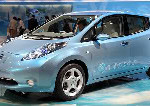
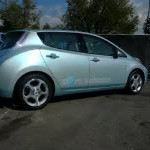
This is the description that Plug-In America’s Paul Scott bestowed upon the new Nissan Leaf, a sleek electric vehicle that will be introduced in the US next fall. I finding this telling, as it’s what I’ve advised the industry since I became involved as the VP Marketing at EV World 18 months ago: make the right statement with the design. The Aptera‘s design is cool, but how many people want a car that looks like that?
Understanding and appreciating the psyche of the customer is critical – and I normally like to do this by survey; it’s best when a client places a real value on market research and funds a statistically valid sample of one-on-one interviews that enables me to get my finger on the pulse of the market. Absent that, we have to guess, which is always a bit frightening. But here, I think we can take a pretty darned good guess.
EV customers want to be noticed, respected, and tacitly yet sincerely thanked for their enlightened contribution to environmental stewardship.
EV customers do not want to be regarded as self-deprecating weirdos, ridiculed for their willingness to throw away all material comforts to protect some species of rare earthworm.
To me, design speaks to this very directly. And I agree with Paul: Nissan has nailed it. Let’s hope that behind this announcement there is full, unflagging commitment to production and distribution, and that we’re standing at the dawn of a new era of electric transportation.
Related posts:
Market Research and Demand for EVs
| August 31, 2009 | Posted by Craig Shields under Electric Vehicles |
Thanks for the “Brass Tacks.” I am not suprised at your finding that market surveys very often ask the wrong questions and so get the wrong answers. The most recent in the auto field was of course the Ford Edsel.
I’m not sure that was the most recent, but in any case, thanks for the comment. And you’re so right about research – especially groundbreaking, paradigm-shifting things. I suppose all the discussion of consumer demand for EVs is mere speculation at this point. As you know, I personally believe that an EV at a good price and a decent range will sell like hotcakes—especially if it’s a family’s second car.
Speaking of paradigms, I think a great number of us are tired of “dad’s car,” “mom’s car,” and “Junior’s car.” We’re more than willing to trade that in for “the car for local driving” and “the car we take out of town when going someplace that will take us through a substantial stretch of questionable charging infrastructure.”
Even more to the point, I think a great number of us are rethinking our role as “consumers,” a word that actually means “destroyers.” Fortunately, more and more of us are not happy going through life destroying things for our own fleeting convenience.