Posts Tagged by Martin Perl
Renewables and Cutting-Edge Physics
| November 12, 2009 | Posted by Craig Shields under Renewables - Science |
Given the realities of our time, most of us are short-term focused – even those in renewable energy R&D. We tend to want to know what can we do NOW to lower our carbon footprint and lessen our dependence on foreign oil. I’m not saying that this thinking is flawed, but occasionally I like to ask questions that attempt to get at the long-term answers as well.
To that end, in preparing my book on renewables, I’ve conducted a few interviews with extremely senior physicists, and asked questions about the theories and experiments in the lab right now that may change the may we power our world 100 years hence.
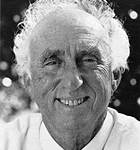
One such interview was yesterday’s, featuring Martin Perl, Nobel Laureate in particle physics – a man so brimming with warmth and kindness (not to mention overwhelming intelligence) that I really hated to leave when the interview was over. We sat just a few feet from the Stanford Linear Particle Accelerator — a device that speeds up particles – normally electrons – to velocities just under the speed of light – and then subjects them to various conditions, e.g., strong magnetic fields. Suffice it to say that wild things happen under those conditions.
The reason I traveled those 300+ round-trip miles was my belief that:
- the point of cutting-edge physics is to understand the ultimate building blocks of the universe,
- depending on whom you believe, we as a civilization are somewhat close to achieving that understanding, and
- with that understanding will come (somehow) an endless supply of clean energy
But surprise! Dr. Perl’s beliefs are 180 degrees opposed to these points. Summarizing an hour-long conversation, one that was both fascinating and disappointing at the same time, he believes that we’re nowhere close to understanding those building blocks and mechanics of the universe, and, even if we were, there is no indication that clean, useful, and inexpensive energy would ever come as a result. (Having said that, there are some extremely powerful implications of Dr. Perl’s work that will be a true boon to mankind in other areas, e.g., medical science.)
So what’s the take-away from all this for us fans of renewables? I suppose it’s this: If you believe Dr. Perl – and it’s hard not to given his credentials – we’ll have to look elsewhere for a long-term answer to our energy challenge. In a way, I suppose, that ratchets up the pressure to find answers using today’s technology that work within the confines of the law of conservation of energy as we know it. And is that impossible, when the sun bestows 6000 times more energy each day on the earth that all 6.8 billion of us consume? Hardly.