Posts Tagged by Mitsubishi
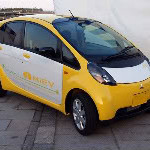
Electric Vehicles — Mitsubishi's i-MiEV Is Coming Soon
| July 6, 2010 | Posted by Craig Shields under Electric Vehicles |
The role I play as a partner in EVWorld.com enables me to have conversations with people very much at the center of the EV Adoption Curve discussion. I just got off the phone with Joe Delello, currently the man closest to the release of Mitsibishi’s i-MiEV, slated for November 2011 in the US.
I told him what cynics are saying about the sincerity of OEMs in the EV space (as if he needed to hear it from me), i.e., that there is no incentive for the OEMs to move this along as neither they nor their dealers make money. He made some good points, which I’ll share:
Automakers are understandably cautious. They want to see how batteries perform in hot and cold climates, they’re worried about lithium shortages, charging infrastructure – and consumer demand beyond tree-hugger early adopters.
However, he’s honestly optimistic. He points out that Americans have already shown how irritated they are at $4/gallon gasoline, and believes that gas prices are likely to generate demand from people who otherwise would not be interested.
Having said that, there will only be 2000 i-MiEVs sold in the US in the car’s first year –a year in which there will be 20 million cars sold with internal combustion engines. 2000 units? One out of 10,000? I should say that’s cautious – to say the least.
For what it’s worth – and I told Joe this – I absolutely adore the I-MiEV. I was lucky enough to test-drive one at the 2008 Los Angeles Auto Show – it’s a cute little rocket. And it will be priced significantly under $30,000 – much less than the LEAF. I could sell 2000 of them in Bismarck, North Dakota.
Thoughts on the EV Adoption Curve
| March 16, 2010 | Posted by Craig Shields under Electric Vehicles |
Every so often, I like to write a short article that gets us thinking about the rate at which electric vehicles will be assilimated into our culture and brought onto our roads, replacing internal combustion engines. Here are a few ideas to consider.
1) What does Big Auto think (or, at least, claim that they think) about EV production rates? Considering there are 230 million cars on the road in the US alone, the needle will not be moving in the short-term:
Nissan: Has pre-orders for 56,000 LEAF all-electric cars.
GM: Last year, had 50,000 expressions of interest in the Chevy Volt, though presumably that figure is somewhat larger now.
Mitsubishi: Bumped up its 2011 production schedule of the i-MiEV from 8,500 units to 9,000.
Better Place: Placed an order with Renault for 100,000 electric vehicles based on the Fluence ZE for its deal with Israel.
2) But is there any reason to believe anything coming out of Detroit?
Today, the population of Detroit is about half of what it was in 1950. The city has 33,500 empty homes and 91,000 vacant lots. A recent AP article asserts that vacant property totals 40 square miles. But Big Auto is not at all apologetic for the meltdown, and points out they couldn’t have foreseen the dynamics of oil prices that created sharp inflection points in the demand for fuel-efficient vehicles in favor of the Hummer and other gas-guzzlers. If this is false, they’re disingenuous; if it’s true, they’re incredibly obtuse. Either way, it’s hard to trust what they’re saying.
One thing for sure: there is nothing good in EVs for the big OEMs. They are happy to drag this transition out for decades, selling gas- and diesel-based cars and trucks as long as possible.
3) The Department of Energy apparently is not bullish on pure (battery) EVs.
Check out this report on the future of the automobile. Although the author sees lots of hybrids in our future, he really doesn’t see any pure EVs. Remarkable. I have to think this is simply a mistake.
4) Industry analysts are hedging their bets.
As reported in EV World, Accenture recently performed a survey that showed that six out of 10 consumers are more likely to buy a hybrid or electric vehicle “only when it is superior to gasoline-only models in every way.”
I understand that merely “being green” isn’t good enough for the vast majority of car buyers. But this report strikes me as the usual MBA malarky — a consultant who reads your watch and then tells you what time it is. What about the other 40%? Isn’t that a substantial market? And what exactly does “superior in every way” mean, exactly? How will the typical consumer react to a value proposition that includes dramatically lower fuel cost and huge reductions of other pieces of his total cost of ownership?
My belief: Give me a freeway-speed battery EV with comparable fit and finish to a garden-variety 5-passenger sedan, a 75-mile range, and price tag under $25,000 after rebate, and you won’t be able to manufacture enough of them.