Posts Tagged by MPG
Plug-In Hybrid Electric Vehicles
| February 4, 2010 | Posted by Craig Shields under Electric Vehicles |
I happen to be looking through an issue of Car and Driver yesterday and noticed their discussion of the EPA’s struggle to measure and report MPG ratings for plug-in hybrids. Apparently, there are people who fail to realize that this is a completely meaningless number. Those who never exceed the battery-only range never need gasoline, and thus experience an infinite number of miles per gallon. Those who never charge their cars experience whatever number is associated with the size and efficiency of the internal combustion engine as it operates their car, given its weight, wind resistance, etc. Of course, most people will experience a number in between – say between 100 and 1000.
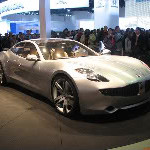
But is that really helpful? Can’t we just note that this is metric that doesn’t apply? I had a friend in college who would ask, “How long is a piece of string?” and “Is it shorter to New York, or by car?” It seems to be that the people seriously pursuing MPG ratings for the Chevy Volt and the Fisker Karma are asking questions that have no more meaning than that.
Related posts:
What MPG do Plug-in Hybrid Owners Get?
| August 4, 2009 | Posted by Craig Shields under Electric Vehicles |
A reader takes issue with my comment that, if driven a certain way, PHEV owners would experience “near infinite MPG,” referring to it as “dishonest and disingenuous.” He goes on, “Energy is still being consumed, that must be produced somewhere and has a cost. In all cases the energy should be taken into account. Perhaps we will need a new metric in future, but for the time being documents such as yours should talk about mpg-e, or miles per gallon-equivalent.”
There are two issues here. One is the actual MPG (in terms of gasoline) that drivers experience, and this itself is a hot topic. I’ve had numerous conversations with Tony Posawatz, the Vehicle Line Director for the Chevrolet Volt, about his frustrating dialog with the EPA over the difficulty of assigning a fair MPG number to the Volt.
This reader’s point, however, concerns the carbon associated with the electrical powerer being used. And of course he’s right that even a pure EV has a carbon footprint that includes the cost of generating the electricity. As I’m sure readers are aware, even with the dirtiest power generation technology (coal) with no modification to sequester the carbon, EVs still represent a significant boon to the environment. And, of course, as the migration to renewables progresses, this will only improve. This whole calculus makes it virtually impossible to identify an “MPG-e” with any real accuracy.
I can assure the reader that I had no intention of being dishonest, btw. “Wow,” as my teenage daughter would say, as she rolled her pretty green eyes.
But let us not forget, as I’ve written elsewhere, we could charge 90 million EVs this very evening with off-peak power that would otherwise be dumped back to ground. And we’re a very, very long way from having 90 million EVs on our roads.