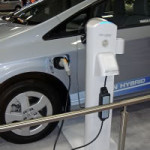
I spoke with a couple of the people promoting the 2012 release of the Prius plug-in hybrid yesterday at the 2010 Plug-In show. Gosh, this seems like a strange concept. Its all-electric range? 13 miles. The net effect for the typical customer? A bit better gas mileage. “This is what Prius customers want – a more efficient Prius,” one guy told me.
I was incredulous. Maybe they want that now, pal. But do you honestly think they’re going to want that two years from now, when they can have a LEAF, an I-MiEV, a Mini E, a Volt, or half a dozen other EVs of various sizes and types? You’re going to ask them to go through the exercise of plugging their car in, just to get slightly better gas mileage?
This is a truly terrible idea. I have to think something has gone terribly off the rails there. Unless they make a major change, I predict that Toyota’s decade 2005 – 2015 will be the biggest single meltdown in automotive history.
A recent article in Japan’s Nikkei newspaper urges the country’s automakers to head directly to battery EVs, rather than further protracting the lives of hybrids. The piece suggests that both Toyota and Honda must shift towards EVs, or risk having the nation of Japan fall behind the competition:
…both Toyota and Honda had until recently thought that the era of hybrids would continue for a while before electric vehicles began to gain popularity. But the automakers are now accelerating their efforts to develop electric cars, and there are two main reasons for this. One is the tough new fuel economy rules the US administration of President Barack Obama will introduce in 2012…The second reason for the heightened focus on electric cars is China’s move to promote them.
This advice, which is what millions of other people and I have been saying for years, is so obvious that it’s really rather ridiculous. Both Toyota and Honda, with their huge balance sheets and engineering staffs, could have done this in a heartbeat anytime they wanted over the past decade. Why didn’t they? I can think of only one reason – that they were already perceived as green – and saw no reason (other than decency) in offering a product that would bring an end to an existing profit stream.
Now, their backs are up against the wall, forced to move fast to avoid being marginalized in a world that’s running 100 MPH towards EVs. I hate to sound like a Monday-morning quarterback, but couldn’t someone somewhere have seen this coming?
One of my duties as a partner in www.EVWorld.com is occasional proofreading; every few weeks, Bill Moore asks me to review his newsletter, The Insider. I look forward to this, as it forces me to keep up on the news in electric transportation, and the proofreading requires almost no more time than would be consumed in simply reading Bill’s insightful writing. And frequently it makes me smile.
You may have noticed that last week brought us another wrinkle in the litigation in which Florida-based Paice Corporation sued Toyota and Ford Motor Company – a dispute involving Paice’s assertion that both the Toyota and Ford hybrid drive systems violate its patent and that it is entitled to compensation.
When I came across this sentence: As you might imagine, Toyota certainly wasn’t happy about the Texas jury’s decision, nor when they lost their apparel to the U.S. Supreme Court, it took we a few seconds to discern what Bill had intended. They lost their shirts, perhaps? No, I ultimately realized that what they had lost was their appeal, not their apparel.
So what was the news? None of the parties in the lawsuit will say how they settled, but Bill thinks “we can safely assume that Paice and its attorneys broke out bottles of bubbly last week, even if they it means they’ll likely never do business in Detroit again.”
I’m hoping that readers of my upcoming book on renewables will enjoy my conversation with Matt Simmons, arguably the loudest voice on the issue of peak oil. And, although the subject remains controversial, it’s probably a good deal less so today that it was last week, now that two extremely senior automotive industry executives have come out with statements that support it.
In particular, note the recent comments of GM’s Bob Lutz, global climate change skeptic, who is nonetheless a strong proponent of the Volt and the electrification of the automobile. Lutz argues that continued dependence on oil as demand inevitably increases will simply exacerbate boom and bust economic cycles. He notes that, in 20 years the China auto market will equal the rest of the world combined and adds, “At that point we have to have alternative drive systems, which to me have to be electric.”
And check out the remarks of Jim Lentz, President and COO of Toyota Motor Sales. He apparently stunned his interviewer during a recent Commonwealth Club event, in which he stated unequivocally that Toyota believes that peak oil will occur sometime in the later half of this decade.
Peak oil – just one of the many reasons for the rapid migration to renewable energy.
Not to harp on the obvious, but without vigorous grassroots efforts to the contrary, the migration to renewable energy and clean transportation will be slow and arduous. In news that underscores this point, Toyota unveiled its new plug-in hybrid, promising sales in 2011 at an “affordable” price. Executive vice president Takeshi Uchiyamada told an eager audience that Toyota’s plug-in travels 14.5 miles as an electric vehicle on a single charge.
Not everyone agrees with me on this, but I find this product — and the timing of its launch — a considerable snooze. Toyota could have had a plug-in hybrid with 30 – 50 mile electric-only range in the market many years ago. Why didn’t they? Because it wasn’t in their interest to do so. They were already perceived as “green” (with the Prius), and there was nothing in it for them to move this along until they absolutely had to.
This offering is good for Toyota in every way. The small battery pack will be easy to build, support, sell – and ultimately replace with new technology as soon as it comes along. The fact that most drivers will be disappointed in that they will continue to use gasoline on a daily basis is apparently not a significant part of the equation.
I’m reminded of shopping at Costco, the experience of which always leaves we thinking: I’m not buying what’s good for me; I’m buying what’s good for Costco to sell me – whatever they can source inexpensively, and sell in quantities that are almost always far greater than its customers want. Need a canister of salt? Think you can get it at Costco? No, if you want salt, you get a 25-pound sack – sufficient to last a family of four about 30 years.
But is it fair to expect altruism from Toyota — or any other corporation, when their sole purpose is to make money? Today’s corporate titans think of themselves as “customer-focused,” though that’s for business reasons, not out of true concern for fulfilling customers’ needs. If that weren’t the case, we woudn’t have planned obsolescence — products that are built to wear out and fall apart, necessitating replacement by new ones.
The bottom line is this: at the end of the day, electric transportation will not come from the “push” of the OEMs; the only thing we have going for us is the “pull” from customers like me (and, I hope, like you) who simply refuse to buy another 25 MPG planet-buster.
Recent Comments