
Ultracapacitor Breakthrough – Reticle Carbon

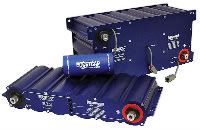
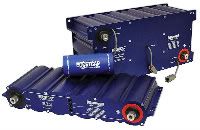 Advocates of electric vehicles understand that there are many interesting variations in potential drivetrains, and that ideally, we would combine ultracapacitors with batteries to deliver stored energy as needed to provide power intelligently, based on the needs of the driver. Where batteries separate positive and negative charges chemically, capacitors do so physically, much like the static electricity that builds up on the surface of a balloon. And where a battery relies on a chemical reaction to release energy, which is relatively slow, the discharge rate of capacitors is typically much faster, which is handy for creating rapid acceleration.
Though batteries tend to gather more attention in the news, I’m always interested in breakthroughs in either device, as both are important in moving the migration to EVs along. Augmenting a battery back with ultracapacitors increases the range of an EV by as much as 400% over that which would have been achieved with batteries alone — so this is a very big deal, as one can readily understand.
I spoke just now with Jack Mastbrook, the chief marketing officer of Northern California-based Reticle Carbon, whose technology seems to represent a quantum leap in the appeal of capacitors in EVs.
Briefly, capacitors are typically granulated, porous, highly conductive carbon. The problem that most manufacturers face (e.g., Maxwell and Nesscap) , is that the process of consolidating this material greatly compromises its utility; the glues and resins reduce the carbon’s porosity and conductivity. Reticle’s patented breakthrough is a consolidation technology that does not use these binders, resulting in much higher surface area and conductivity of the carbon, thus a thicker electrode. The result: 10 – 20 times the power density. Jack is understandably both proud and excited. “To augment a 350V lithium-ion battery pack, Maxwell’s capacitive array weighed 150 pounds. Ours would have weighted 20 pounds,” he told me.
The company’s trying to raise investment capital. Given the interest in EVs in today’s market, that doesn’t sound like too difficult a task.


This sounds very promising, although I question whether using ultra capacitors would increase the range of a vehicle by as much as 400%.
Batteries lose efficiency when they are called upon to deliver quick acceleration or store energy during quick stops. On the other hand, capacitors to not lose much efficiency under those circumstances. So, combining ultra capacitors with batteries makes good sense for both full electric vehicles and hybrid vehicles. It would complicate the electronics, but modern electronic technology and software should be able to deal with that.
So much potential and yet miisnsg it.One easy area for you would be on electric cars. Not as a replacement for batteries (not yet), but as a range extender. In particular, assume that a number of EVs would agree to add a high voltage DC or AC plug along with control pins on the back of a car, as well as a standardized rack mount system that could carry say 100-200 KGs. This would allow a car owner to add a rack to the back of the car in which extra energy is available. I doubt that many will want to buy these. Instead, they would rent them from a company. If you could get tesla, Nissan, Toyota, and perhaps Ford to agree to a standard, you could approach one or more rental car companies to provide a unit from you. The fact that it can be charged quickly, would allow for say 50 mile extensions, with say 5 minute charges. That is not what I would want to do daily, but for anywhere from 1-6 times a year, it makes sense.