Posts Tagged by Plug In America
Paul Scott on the Role of Government in the Migration to Electric Vehicles
| June 2, 2010 | Posted by Craig Shields under Electric Vehicles |
Another clip of Paul Scott’s appearance on The 2GreenEnergy Report. Here, the subject is the role of government in the migration to electric vehicles.
Full 30-minute show on electric transportation here.
Paul Scott Discusses Plug-In America on the 2GreenEnergy Report
| May 31, 2010 | Posted by Craig Shields under Electric Vehicles |
When guest Paul Scott was on the 2GreenEnergy Report recently, I asked him about the organization he co-founded: Plug-In America.
The Electric Vehicle Adoption Curve
| March 24, 2010 | Posted by Craig Shields under Electric Vehicles |
I spent the better part of yesterday afternoon in a television studio in Ventura, interviewing Plug-In America vice president and co-founder Paul Scott. Paul had generously committed the time, and drove his Toyota RAV-4 EV up from Santa Monica for the occasion. I hope to have the interview chopped up into 3 – 4 minute segments and up on YouTube shortly. A still shot from the studio is below.
I walked away from the process far more hopeful and optimistic than I was when I first sat down. Here’s why:
Read More
Paul Scott and Plug-In America
| February 24, 2010 | Posted by Craig Shields under Electric Vehicles |
I encourage readers who may be interested in electric transportation to sign up for Paul Scott’s blog. Paul is a spokesperson for Plug-In America, and one the great forces for progressive environmental policy. He also happens to be a terrific writer. I notice that he gathered a number of rave reviews to a recent post in which he concluded:
I don’t I don’t know about you, but I can’t wait till the day when it’s rare to see an internal combustion car. At some point, they’ll be anachronistic reminders of a day when people didn’t think twice about spewing poisons into the common airshed. Like smoking in line at the grocery store, you won’t believe people used to do it everywhere.
I responded:
Paul, I agree with the others — you really are one of the great writers on the subject. For what it’s worth, the analogy I use is women wearing mink coats — all the rage in the mid-60s, but completely gone from our culture a few years later, when we all gasped in the collective recognition that it was simply wrong. And this is exactly what I expect will happen with internal combustion engines: they will become regarded as something we used to do – something that no longer has a place in our world.
Nissan's Leaf: "Distinctive"
| November 15, 2009 | Posted by Craig Shields under Electric Vehicles |
“It’s distinctive without being bizarre.”
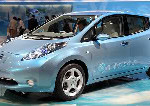
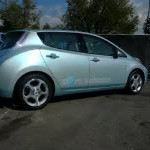
This is the description that Plug-In America’s Paul Scott bestowed upon the new Nissan Leaf, a sleek electric vehicle that will be introduced in the US next fall. I finding this telling, as it’s what I’ve advised the industry since I became involved as the VP Marketing at EV World 18 months ago: make the right statement with the design. The Aptera‘s design is cool, but how many people want a car that looks like that?
Understanding and appreciating the psyche of the customer is critical – and I normally like to do this by survey; it’s best when a client places a real value on market research and funds a statistically valid sample of one-on-one interviews that enables me to get my finger on the pulse of the market. Absent that, we have to guess, which is always a bit frightening. But here, I think we can take a pretty darned good guess.
EV customers want to be noticed, respected, and tacitly yet sincerely thanked for their enlightened contribution to environmental stewardship.
EV customers do not want to be regarded as self-deprecating weirdos, ridiculed for their willingness to throw away all material comforts to protect some species of rare earthworm.
To me, design speaks to this very directly. And I agree with Paul: Nissan has nailed it. Let’s hope that behind this announcement there is full, unflagging commitment to production and distribution, and that we’re standing at the dawn of a new era of electric transportation.
The Nuclear Industry – Down But Not Out
| November 3, 2009 | Posted by Craig Shields under Nuclear |
A colleague sent me an article that starts: “A nuclear renaissance needs government funding to move ahead,” and then goes on to extol the virtues of this horrifically dangerous and expensive technology. (If you’re interested in reading it, you’ll have to find it with a search engine; I don’t want to empower it with backlinks.) I responded:
How utterly nauseating. As Paul Scott (VP at Plug-In America) said in response to a question I asked him during the panel discussion I moderated at the AltCarExpo a few weeks ago, “Prepare yourself for a steady onslaught of lies from the nuclear and fossil fuel people. If you thought it was bad in the 1990s with the Zero Emission Vehicle (ZEV) mandate, you ain’t seen nothing compared to what they’re about to throw against EVs and renewable energy in the next couple of years.”
Of course, this is an excellent example. “Needs government funding?” You bet your sweet $%^ is does. Help will come only from people who have been paid off handsomely; the idea certainly will receive identically zero support from a fair-minded and informed citizenry.
Another AltCarExpo in the Books
| October 4, 2009 | Posted by Craig Shields under Electric Vehicles |
I functioned as the moderator of the “Charging Infrastructure” panel before a full and enthusiastic audience at the 4th annual AltCarExpo last Friday, October 2nd. For the first hour, AC Propulsion’s CEO Tom Gage, Plug-In American’s Paul Scott and Clean Fuel Connection’s Enid Joffe did a wonderful job with the questions I had prepared. At that point, I turned the questioning over to the audience for the last 30 minutes, and was pleased to see a steady slow of clear, solid questions that got at some really good issues that I had not built into my dialog with the panel.
As one might have expected, the content was mostly technical: Exactly what are the challenges that the utilities face in preparing for the coming ubiquity of electric transportation, and how are they going their work? What does the advent of V2G (vehicle to grid) mean in terms of both the quality and quantity of power available on the grid at any point in time? What type of planning needs to occur such that charging stations provide adequate opportunity to ensure that motorists feel confident that they won’t run out of charge in their day-to-day driving?
I knew in advance that Tom Gage would be impossible to stump with questions like these (not that I was trying), insofar as he’s one of the best-informed people on the planet in this regard. But I was blown away with the expanse of technical knowledge that Enid and Paul had brought to the table as well.
I made sure we addressed the political issues too, and I’m happy to say that no one pulled any punches. Apparently, the oil companies are not going to take this without a fight. “You’re about to see a campaign of lies like you’ve never witnessed before,” Paul Scott intoned solemnly. “In the last wave of hearings that could have threatened their monopolies, they hired hundreds of people to show support for their positioned who had never even heard of the issue the day before and didn’t know the first thing about it. They have absolutely no concept of fair play – and that was just a warm-up for what is about to come.”
I closed by thanking the panel — and the audience in particular, with my reference to Henry Kissinger that readers may have seen in other posts. “Henry Kissinger said recently,” I reminded the group, “that if it weren’t for the intensity of the opposition to the war in Vietnam of the common American, we’d still be there. That’s an utterly amazing thing to admit, isn’t it? It shows me several things, but the most obvious is the raw power of people like you, who take their time to come together and stand up for something you believe in. I thank for you that. And I ask you to give yourselves a hand.”
Zan Dubin Scott on Plug In America and Renewable Energy
| July 29, 2009 | Posted by Craig Shields under Electric Vehicles |
Zan Dubin Scott is a name known to most of us in the “plug-in” and renewable energy worlds. She is a tireless advocate and public relations professional, volunteering enormous amount of her time and pouring unlimited energy into the cause of electric vehicles and green energy. I’m proud to call her a friend.
… And I was lucky enough to catch her on the phone just now for a short conversation, which I publish here:
Craig Shields: I hope you still have your (electric Toyota) RAV-4. What a cool car. And they’re like hen’s teeth at the point.
Zan Dubin Scott: Of course. And you’re right, they’re hard to find.
CS: It strikes me that you’re one of the rare people who is lucky enough to have a career that is truly built around a personal passion. Would you say that this is true?
ZDS: Absolutely. It’s awesome to be paid for doing what I love.
CS: If I may ask, how did this get started?”
ZDS: Shortly after I married my husband, he was diagnosed with bladder cancer. At that moment, he said, ‘Forget about waiting; I’m going to do all the things that I’ve dreamed about.’ And one of those was to buy and install solar panels on the house. So we did that, and we also got the RAV-4. And really ever since then I’ve worked hard for environmental causes.
CS: Please tell me about your involvement in Plug In America. I’ve met Chelsea Sexton and Chris Paine, and I’m a huge fan.
ZDS: It’s an amazing bunch if diverse, though truly committed people. Each one is terrific in his or her own way. I volunteer as the communications director. Plug In America plays a critical role in advocating for electric vehicles, though originally, it was called Don’tCrush.com, while the car companies were gathering and crushing the EVs. There is a story here that millions of people need to hear, and we’re telling that story.
CS: What do you see as the main hurdles to getting where we need to go with respect to EV and renewables?
ZDS: First of all, we couldn’t have asked for better, more visionary people than Obama and (Energy Secretary Steven) Chu. They’ve committed $14.1 billion in stimulus money to EVs – largely batteries and infrastructure. Thousands of companies – some of them small and entrepreneurial – are all hoping to play an important role here. This money will definitely accelerate the process.
CS: When you talk about infrastructure, what exactly do you see developing?
ZDS: A certain level of EV commercialization will be achieved with people simply charging at home. But, for wide scale adoption, we need a standardized public charging infrastructure. If we don’t have that, people are going to be concerned about getting stranded, although that’s never happened to me in seven years of driving an EV. It’s never happened to a single EV driver I know. Still, it’s a chicken and the egg situation. Ideally, we would grow acceptance and infrastructure at the same time.
And there will be fits and starts. BMW’s a good example. The car is great, but there have been some delivery and customer service issues.
CS: What about renewable energy? We can plug in 90 million EVs this evening and not build a single additional power plant. But don’t we have to advocate for clean energy generation as well as consumption?
ZDS: Indeed. And Plug In America is really starting to get onboard with that as well. It’s in virtually everything we publish now.
CS: I seem to recall that your have a deep background in the political side of these issues. And personally, you know that I’ve always said the technology issues are dwarfed by the political issues. Do you mind commenting?
ZDS: Not at all. That’s another role of Plug In America, to correct the misinformation that the public receives from the car companies who most definitely do not want this to happen. EVs have no repairs and use no gas. We’ve replaced the tires and the shocks on our RAV-4, but that’s it. That’s not good if you’re an oil company or a car company. I’m writing a piece just now on the “myths and truths” associated with EVs.
Here’s a good example of how this works. The car companies are pushing for hydrogen fuel cells, because they know that if this is possible at all, it will happen in the distant future. A commitment to hydrogen takes the pressure off of EVs. Chu decommited the DoE from hydrogen. But it’s back. Congress and several states have passed several million dollars in grants to hydrogen. This isn’t an accident. It’s pernicious. The oil companies are pushing hard for it. The car companies are so weak at this point that they don’t have the power to push for this–and I don’t think they would even if they could; at this point, every major car company on earth has made a sincere commitment to EVs.
Having said this
CS: Wow, Zan. Thanks for the update. You never stop. That’s one of the things I most admire about you.
ZDS: Thanks, Craig.
** I’m happy to report that Zan’s husband’s cancer has been in remission for seven years; he’s “out of the woods.”